

We all want to be better putters. Harvey Penick, the legendary head pro at the Austin Country Club in Texas and author of The Little Red Book, famously said, “A good putter is a match for anyone. A bad putter is a match for no one.” What does it mean to be a good putter? The short answer: A good putter gets the ball in the hole. Consistently.
Thirty-six is the regulation number of putts per round. If you take 36 putts, are you a good putter?
If you track your putts while playing, you’re probably looking at three numbers at round’s end: total putts, number of three-putts, and number of one-putts. Great start, and everyone should always do that—but numbers alone don’t tell the full story of how you putted.
Using actual putting data is only the first step. As we look beyond the numbers we start to see patterns as well as connections between putting and other parts of our game. This opens us up to see our strengths as well as areas that might need work. When to put more emphasis on pace for example, or when line needs more focus. How our short game, especially chipping, is intertwined with our putting.
That’s the discussion here, but it’s only a part of the story. Others are discussed in Read Wide, Aim Narrow, as well as Stop Thinking. Start Putting. One covers reading greens the other highlights neurological research to help us understand we have two minds—analytical and intuitive—as well as two memory systems—procedural and declarative.
Are You a Good Putter?
It’s kind of a trick question, because some days we putt great and other days the ball never goes in the hole. I prefer a different question: How do I become a better putter? As with all things golf, improvement is a lifelong journey, and despite the endless supply of videos, tips, and many hours playing golf, we are in the end, on our own.
Pace, Line, and Stroke
Good putting requires getting three things correct: pace, line, and stroke. The majority of golfers get the line right more often than pace, and when I say more often, I mean a lot more. It’s easier to see line which engages our analytical mind than it is to feel pace, the job of our intuitive mind. If we view a putt from the low side, halfway between ball and hole, our intuitive mind will judge pace better than looking from behind the hole or behind the ball. But once you determine if it’s uphill or downhill, your mind still has lots of work to do, as determining pace involves multiple variables.
Line is easier to see because the green’s contours help us visualize the path the ball might follow as it rolls toward the hole. Be advised, studies confirm that brains prefer curves to straight lines, and brain scans show why: specific regions respond to curvature itself. This can lead to thinking the putt will turn, even when that section of the green is actually flat.
The USGA recommends that the holing-out area—two to three feet in diameter around the hole—have a maximum grade of 3 degrees. This means the steepest slopes are usually well away from the hole and easier to see. The closer we get to the hole, the more subtle the slope, making it harder to see.
With that understanding, we can begin to simplify how we think about putting. When we have long range putts it will help if we spend more time trying to feel the best pace we can. Shorter putts will benefit more if we work harder to find the best line.
Regardless of the length of putt, proper pace is the most important aspect of putting when it comes to getting the ball in the hole. A golf ball is 1.68 inches in diameter and travels 5.28 inches in a complete rotation, which is probably further than you might have guessed. Two balls will easily fit in the cup, which has a diameter of 4.25 inches. Actually three balls fit.
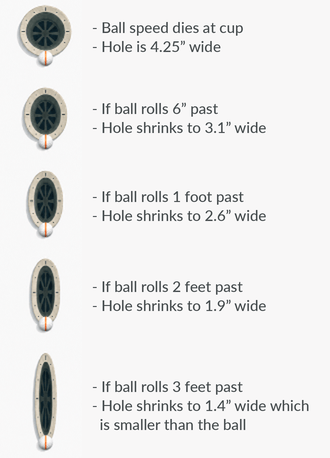
The ball’s velocity and angle at the hole’s edge determines whether it drops or lips out. The technical term for this is “capture speed.” As is illustrated below, the effective size of the hole shrinks fast when you roll it past the cup.
In practice, this means the cup shrinks to 3.9 inches for a ball that goes 6 inches past the hole. One foot past shrinks it even further, to 2.6 inches. A ball rolling two feet past shrinks the hole to 2.6 inches wide while one that travels three feet past is too large to go into the hole which is now 1.4 inches wide. A ball that runs out of speed at the exact moment it arrives at the hole has the greatest chance of ending its journey at the bottom of the cup.
We are trying to place a round object into a round hole, which is no doubt easier than trying to force a square object into a round hole. However our task is harder because the ball is in motion as it approaches the hole which is frequently placed on uneven ground. Because of this, the ball goes in on what looks to be the side of the cup. Some even curl around the back and fall in from there.
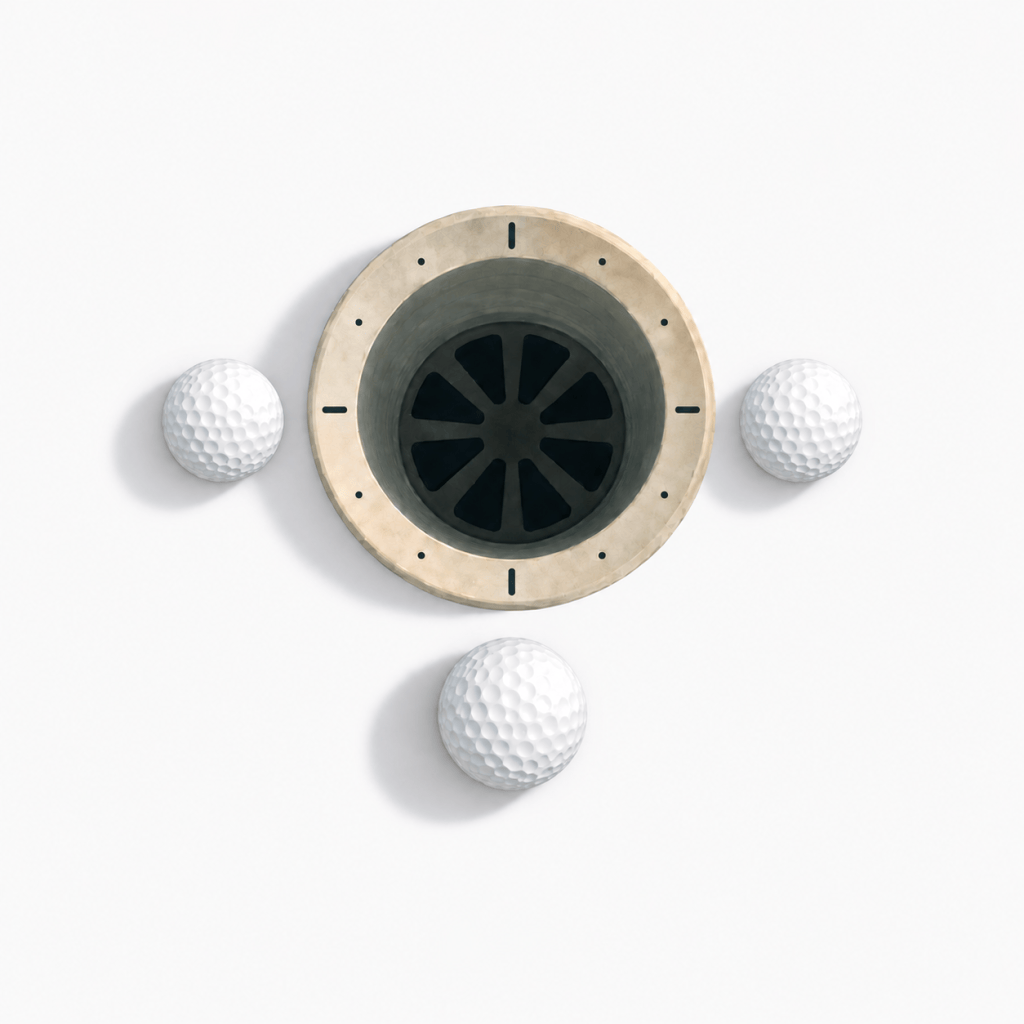
Think of the hole as a clock face. Will the ball enter at three, six, or nine o’clock? Putts that might look like they won’t go in, do, when the pace is perfect. All golf outcomes are influenced by gravity. A fact we can and should use to our advantage when possible.
Pace isn’t the only thing that shrinks the hole. So does the flagstick, if you leave it in.
By rule, the flagstick’s pole can be no more than 0.75 inches in diameter where it sits inside the cup, though most sticks in use are closer to 0.5 inches. Either way, that’s fixed real estate taken out of a 4.25-inch target—somewhere between 12 and 18 percent of it, gone. Unlike pace, which you control, the stick’s footprint doesn’t change putt to putt. It’s simply there or it isn’t.
Since 2019, leaving the flagstick in has been legal, and plenty of golfers now do it, treating the stick as a backstop on downhill or longer putts—a ball hit a bit too firm can still catch the pin and drop. Whether that backstop effect outweighs the space it occupies is still debated, and there’s no settled data either way. What is settled is that the choice isn’t really about physics. The decision to leave it in or not should be about what helps your mind see the cup and commit to the shot. See Why Golfers Can’t Commit. If leaving it in gives you a clearer target and more confidence over the ball, that’s reason enough. If it’s a distraction, take it out. Either way, know what you’re choosing and why.
Three-Putts
Now that you know the hole gets smaller when you go past it, think back to your three-putt holes and ask these questions. Did my first putt finish more than 3 feet from the hole? If yes, was it short or past the hole? If it went past the hole, did I watch it carefully until it stopped? If you did you just gave yourself a free read.
The following story might sound familiar. You hit the green in regulation with a solid approach shot and have a chance at “birdie.” By calling it a birdie putt, you put additional pressure on yourself to hole it. Yes, it’s a birdie putt, but really it’s just another putt. The value of all putts are equal, one stroke. And from a stroke point of view, all putts are straight.
Let’s continue with our story. You don’t convert the birdie putt, and now the next putt is outside your comfort zone—suddenly it’s become a putt to “save par.” A hole that had the potential to subtract a stroke might add one instead. In theory, golf should be linear: advance the ball closer to the hole with each shot. But the realities of playing golf force us to take a zigzag path—something we should accept. See There Is No Straight Line.
Touring pros make roughly 96% of their putts from 3 feet and 88% from 4 feet, so you will have some three-putts.
What about those 25-foot-and-over putts—the lag putt. Golfers are taught to get the ball inside a three-foot circle on long-range putts. Considering the make percentage for a pro on a twenty-five-foot putt is about 10%, it’s a logical strategy. Personally, I’m always trying to make any putt so I don’t alter my objective. I don’t like giving myself two targets—a 3 foot circle and the cup. This is a personal choice, nothing more.
The best way to reduce three-putts is to leave yourself a high make percentage second putt. If most of your first putts finish outside 3 feet short or long, working on your pace should be a priority. The better your pace on the first putt, the fewer three-putts.
All putts count as one stroke. Treat them accordingly. Whether it’s a double-breaking forty-footer or a simple six-inch tap-in, keep your mind in the present moment and your process the same. Always hole out to hear that satisfying sound of ball hitting the bottom of the cup.
In nearly every round I see golfers miss their second putt and immediately lose their awareness. They take a swipe at the third putt and it misses. They take another swipe. No set-up, no thought. That misses. Oftentimes they reach down to pick up the ball and fumble it. They simply chose to stop playing golf. A completely avoidable unforced error that’s harmful to your mental state.
I am a huge advocate of present-moment awareness. It’s similar to focus but differs in one important way. Golfers spend a lot of time traveling between shots. When we arrive at the ball we decide now it’s time to focus. Now is the time? What are we doing with our minds between shots? In contrast, present-moment awareness is a continuous, unbroken span of time that lasts the entire round and I believe it’s one of the most underrated skills we can use to play better golf. It’s a force multiplier. I will be the first to say it’s a very difficult thing to do, but most of us don’t try. Instead we create distractions that make present-moment awareness all but impossible. When you’re on the course you should always be playing golf and only golf.
What do you do with your time between shots?
One-Putts
If you want to post a putting score under 36 without chipping in, one-putts are required. You might hit an approach shot that reaches the green in regulation or less, or arrive at the green as a result of a chip, pitch, or bunker shot. Your short game, is closely connected to your putting because in most cases the ball will roll for a good distance on the green. Good short game players always read the green before they make a chip shot. They survey the green complex in readiness for the putt. A golf shot can serve the next one well, or make it even harder than the one you are about to hit. Look around and you will see choices.
Think about your last few one-putt holes. How many were inside three feet? How many were from ten feet or beyond?
A round with multiple one-putts from inside 3 feet should be looked at closely. You’re either dialed in on your approach shots, or your short game is very sharp—or a little of both, which means you’re playing good tee-to-green golf.
If you missed the green but made a good chip and your first putt finds the bottom of the hole, that’s a successful scramble—the up and down. It’s a valuable metric to track. It measures chipping skill and ability to remain in the present moment long enough to hole the putt.
Once your ball is on the green set aside the shots that got you there, whether good or poor. They no longer matter. What matters is the putt in front of you. It’s not a birdie putt, a par putt, or even a putt for double-bogey. It’s simply a putt. Go through your standard routine. Resist the temptation to stretch out the process—looking at additional angles, or thinking over the putt longer than usual. These actions disrupt flow. For more on that see The Tool You Never Practice.
Practice
Hideki Matsuyama, the Japanese PGA touring pro, is known for his extensive putting practice, day after day, as well as before and after each round. It’s impossible to know what’s going through his mind, but he’s told us he strives for a pendulum motion rather than actively swinging or pushing. He tries to use gravity as much as possible. His motion is maximum acceleration at the top of the swing, zero acceleration at impact—a common trait among elite putting strokes. See Swing Freely.
How one practices is a personal choice. But I’ll pass along some things I’ve observed. Most golfers, if they have a warm-up routine, spend most of it on the range working on their full swing. This is sometimes followed by a few strokes on the practice green, then off to the first tee. See The Practice Blind Spot. How many come back to the practice green after the round? Zero. I encourage you to spend a lot more time putting. Spend at least as much time on the practice green as you do on the range. More, if you can make that commitment. It will show up on the course and in your score.
I don’t worry about holing putts while practicing my putting. I spend my time working on pace by putting a ball away from me with no target. Then I try to hit the next putt the same length, repeatedly. By doing this, I’m focusing on pace and pace only. I don’t care if it’s left or right. Then I change direction and distance and begin again.
Practice greens don’t always resemble the course-green experience so I don’t spend much time trying to practice green reading on them. Instead, I focus on set-up and aim and contact from ten feet, five feet, and three feet. While practicing I ask, am I making solid contact? Is the ball rolling end over end? Now my goal is to hole the putt. This is where I work on learning how to identify when I’m ready to switch from preparation to motion. That’s the moment I commit.
Combine chipping practice with putting practice. Chip then putt. This type of practice mirrors course play by requiring you to take ownership of how you executed the chip.
Leave a Reply