

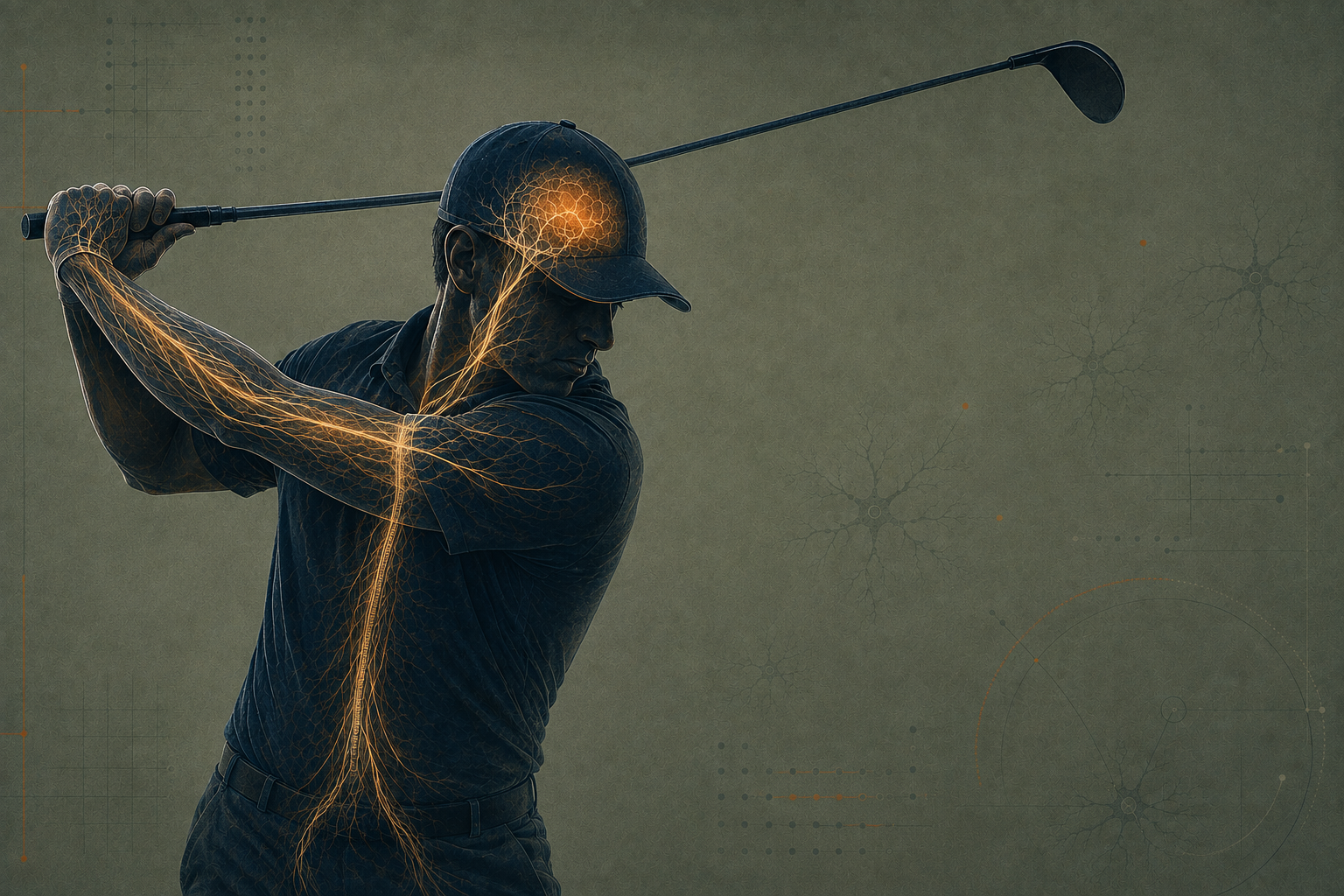
We often talk about “muscle memory” in golf. Grooving your swing. Pitch shots or putts you’ve practiced so many times they’re automatic. Repeatable motions you can trust under pressure.
But your muscles don’t have memory. The proper term is “motor memory.”
Memory lives in your brain—specifically in the neural circuits that produce the motion. Understanding where that memory actually resides, and how it works, changes how we should think about practice and play.
What Motor Memory Actually Is
When researchers use fMRI (functional magnetic resonance imaging) to watch what happens in the brain during motor learning, they’ve discovered that motor memories aren’t stored as descriptions of movements. They’re stored as the movements themselves—as patterns of neural activity that directly produce the action.
Motor memory resides in a network of brain regions including the basal ganglia, premotor cortex, cerebellum, and parts of the inferior parietal cortex.1 But it’s not stored there like a video file on a hard drive. The memory lives in the same circuits that produce the action—the motor cortex, basal ganglia, and spinal cord motor neurons.2
Think about that for a moment. The pattern that creates your golf swing is the memory of your golf swing. There’s no separate file called “my driver swing” stored somewhere in your head. The memory is the executable program—the precise sequence of neural firing that produces the motion.
This is why the basal ganglia contribute to incremental learning of stimulus-response associations.3 You’re not learning about the swing. You’re encoding the swing itself as a learned response pattern. The motion is the memory.
The Efficiency Paradox
Here’s where it gets interesting. If you watched someone’s brain activity while they learned a new golf skill—let’s say a bunker shot—you’d see something counterintuitive.
In the beginning, when they’re consciously thinking through every element of the technique, their brain lights up like a Christmas tree. High activity in the frontal and parietal lobes. Lots of cognitive effort. Slow, clumsy execution.
As the golfer gets better at the bunker shot, brain activity actually decreases as the brain becomes more efficient.4 The most skilled players show less neural activity during execution, not more.
We assume mastery means the brain is working harder. The opposite is true. Mastery means the brain is working smarter—using fewer resources to produce better and more consistent results.
Studies in young adults typically demonstrate an overall reduction in activity when learning progresses, indicating increased neural efficiency.5
From Conscious to Unconscious
What’s actually happening during this efficiency shift? The brain is moving the skill from conscious control to automatic execution.
There is a smooth transition from the visual-cognitive to the motor loop, with a switch from anterior to posterior circuits, from declarative learning to optimization networks.6
In plain English: when you first learn a bunker shot, you’re using the parts of your brain that handle conscious thought, attention, and problem-solving. You’re thinking your way through it.
As skill develops, the work transfers to a different system entirely—the basal ganglia and cerebellum. These structures operate below the level of conscious awareness. They’re specialists in automatic execution.
The basal ganglia don’t think about the motion. They produce it. This system underlies procedural memory, which supports the learning and execution of motor and cognitive skills, especially those involving sequences.7
The motion runs automatically. Below awareness. That’s why we don’t need to worry that when we raise a fork there will be a seamless transfer of food to our open mouth.
What This Means When Practicing
If the motion is the memory, and the memory is encoded as a neural pattern that directly produces the movement, then what are you actually doing when you practice?
You’re not practicing the shot. You can’t. The shot is an outcome—where the ball goes, how it curves, whether it stops near the pin. Outcomes are affected by your motion, but they’re not created by your intention. They’re created by physics responding to the motion you produced.
You’re practicing the motion. You’re encoding—through repetition and refinement—the neural pattern that produces that motion.
Every swing is either reinforcing an existing pattern or creating a new one. The basal ganglia contribute to incremental learning of stimulus-response associations.8 That’s the mechanism. Stimulus (I need to hit this bunker shot), response (this motion), association (this is what I do in this situation).
Do it enough times with enough attention to the motion itself, and the pattern becomes automatic. The memory becomes reliable. The motion becomes uniquely yours.
Why the Distinction Matters
When you step up to a shot on the course and start thinking about the outcome—I need this to stop within six feet, I can’t go left, this has to be perfect—you’re engaging the wrong system.
You’re activating the conscious, cognitive parts of your brain that were helpful during the learning phase but are terrible during execution. Implicit motor learning is governed by procedural memory and occurs below the level of awareness, while explicit motor learning involves conscious recollection.9
The motion you’ve practiced—the one encoded in your basal ganglia as an automatic motor program—doesn’t need your conscious mind’s help. In fact, conscious interference often makes it worse.
The shot you’re trying to produce? That’s not something you can control directly. You can only control the motion. The shot is what happens when motion meets the ball.
This is the difference between trusting the memory you’ve built and trying to consciously manufacture an outcome in real-time.
The Motion Runs Itself
Motor memories are stored in circuits which mediate the behavioral motor pattern.10 The pattern lives in the circuits that run it. When you’ve practiced a motion enough, when it’s truly encoded as motor memory, it doesn’t need conscious supervision.
All it needs is permission to run the sequence.
That’s the key learning and the shift. From trying to control the shot to allowing the motion to play out. From effortful conscious control to efficient automatic execution. From brain activity lighting up to brain activity quieting down.
Incorporating Memory into Practice
It’s much harder to stop thinking about mechanics (conscious control) when standing over a shot, than it is to find a mind state that allows your procedural memory to produce the motion. You can’t think your way into not thinking.
Trying to force yourself to “stop analyzing” just creates another layer of conscious effort. Instead, redirect your attention—give your conscious mind something to do that doesn’t interfere with execution.
Some people can more easily tune out distractions than others. The Swing to Flow process offers a way to identify ways to train your mind to be better at this. The model discusses ways to integrate mechanics, mindfulness—the key to calming the mind—and intuition that allows your procedural memory to run the swing.

The motion is the memory. Practice the motion, play the memory.
The full process can be found in Swing to Flow: A Mindful Approach to Better Golf Revised and Expanded Edition. Also available as an Ebook.
Notes
- “Procedural Memory,” ScienceDirect Topics (2025). The article reviews research showing procedural memory relies on a network including the basal ganglia, premotor cortex, cerebellum, and inferior parietal cortex. https://www.sciencedirect.com/topics/neuroscience/procedural-memory
- “Motor Memory,” ScienceDirect Topics (2025). Reviews evidence that motor memory storage involves the principal circuits that mediate behavioral motor patterns, including motor cortex, basal ganglia, and spinal cord motor neurons. https://www.sciencedirect.com/topics/psychology/motor-memory
- Shohamy, D., Myers, C.E., Grossman, S., Sage, J., Gluck, M.A., & Poldrack, R.A., “The role of the basal ganglia in learning and memory: Insight from Parkinson’s disease,” Neuroscience & Biobehavioral Reviews (2004). Findings in animals and humans indicate the basal ganglia contribute to incremental learning of stimulus-response associations. https://pmc.ncbi.nlm.nih.gov/articles/PMC3772079/
- Berlot, E., Popp, N.J., & Diedrichsen, J., “A critical re-evaluation of fMRI signatures of motor sequence learning,” eLife (May 13, 2020). Systematic assessment reveals widespread activity reductions and subtle pattern changes outside primary motor cortex as motor skills develop. https://elifesciences.org/articles/55241
- “Motor Learning,” ScienceDirect Topics (2025). Reviews neuroimaging evidence showing overall reduction in brain activity as learning progresses, indicating increased neural efficiency. https://www.sciencedirect.com/topics/neuroscience/motor-learning
- Ghilardi, M.F., Moisello, C., Silvestri, G., Ghez, C., & Krakauer, J.W., “The many facets of motor learning and their relevance for Parkinson’s disease,” Frontiers in Neurology (July 2017). Describes the smooth transition from visual-cognitive to motor loop, from anterior to posterior circuits, and from declarative learning to optimization networks. https://pmc.ncbi.nlm.nih.gov/articles/PMC5486221/
- Ullman, M.T., “The Declarative/Procedural Model,” in Neurobiology of Language (2016). The procedural memory system, including basal ganglia and cerebellum, underlies learning and execution of motor and cognitive skills, especially sequences. https://www.sciencedirect.com/topics/neuroscience/procedural-memory
- See note 3.
- Kleynen, M., et al., “Motor Learning,” in Neurorehabilitation Technology (2025). Distinguishes implicit motor learning governed by procedural memory (unconscious) from explicit motor learning involving conscious recollection (declarative memory). https://www.sciencedirect.com/topics/neuroscience/motor-learning
- See note 2.
Leave a Reply