

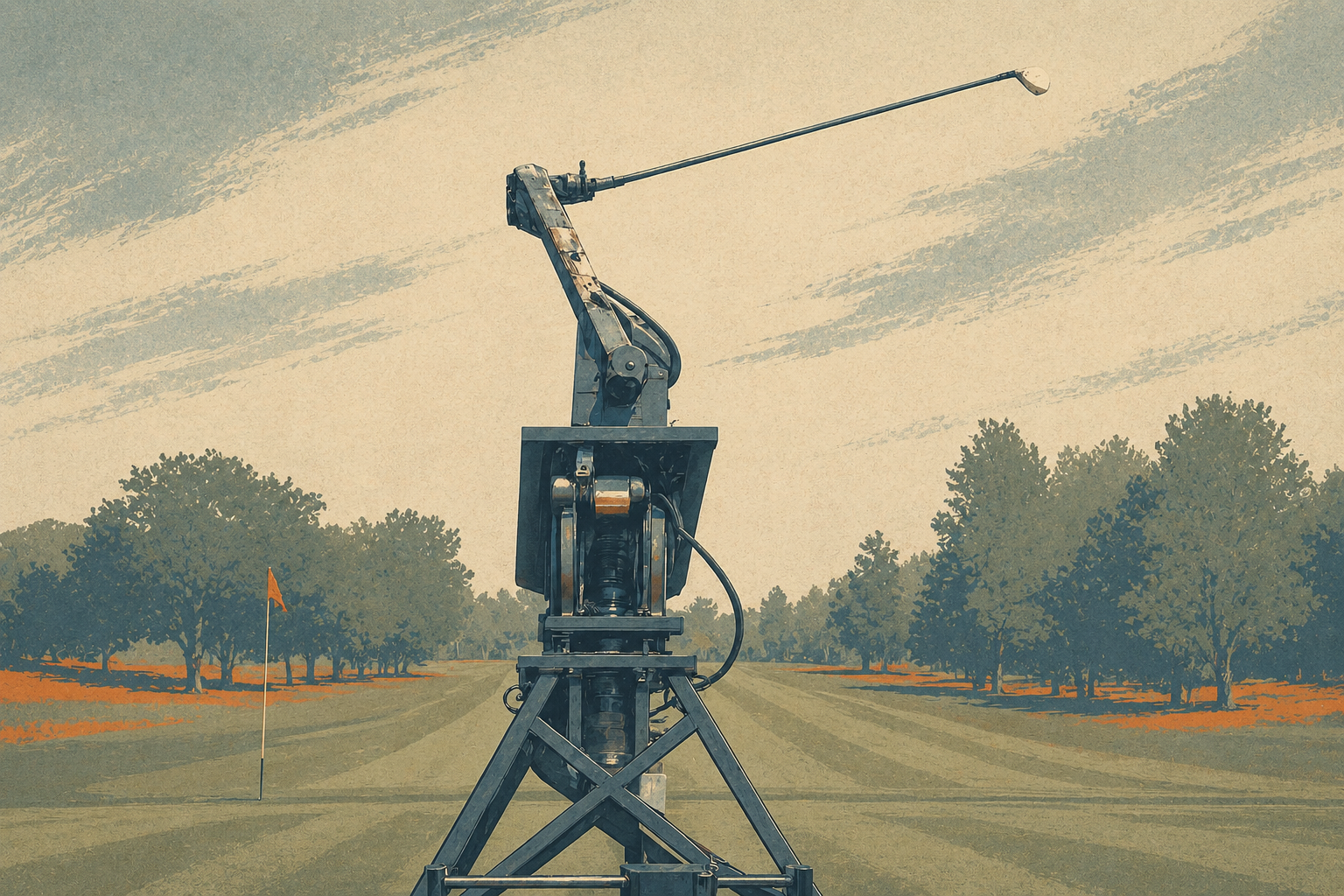
The Golf Labs robot can replicate Tiger Woods’s swing or a weekend hacker’s slice. Set the parameters, press start, and it delivers the exact same shot—perfectly—every single time. The Golf Labs robot has been the industry standard for testing equipment for over 30 years. It’s how manufacturers know if that new driver really adds 10 yards. It’s how the USGA tests ball performance.
Here’s why it works: The robot is a simplified mechanical model of the golf swing using two levers (arm + club) connected by a hinge (wrist). It swings from a stationary position at the top of the backswing, accelerating through impact just like a real golfer would. Servo motors provide the power. Software controls every detail—swing speed (anywhere from 5 to 130 mph), attack angle, wrist release timing, club face orientation. Want a draw? A fade? A pull-hook? Program it in. The robot delivers.
Perfect consistency. Perfect repeatability. Never a bad day.
The Perfect Partnership
The robot achieves this through balance. Hardware and software working as equal partners.
The hardware must be calibrated precisely. Worn parts get replaced. Tolerances stay tight. But even perfectly calibrated hardware is useless without software telling it what to do.
The software contains a bio-mechanical model, the specific parameters for each shot, the precise acceleration curves. Change the software and the hardware immediately executes the new instructions flawlessly. But sophisticated programming means nothing if the hardware can’t deliver.
Neither dominates. Neither is more important. Remove either one and you have nothing. Both systems, working together in balance, create perfection.
The Human Golfer: Hardware and Software
Now consider the human golfer through this same lens.
Your body is the hardware—arms, legs, wrists, muscles, tendons, joints. All the physical components that execute the golf swing. But unlike the robot, your hardware isn’t made of steel and servo motors. It’s alive. It changes constantly. Yesterday’s workout affects today’s flexibility. Last night’s sleep impacts muscle response. Tension creeps in. Fatigue builds. Your hardware is in constant flux, doing hundreds of other jobs beyond swinging a golf club.
Your mind is the software—consciousness, not binary code. It’s been absorbing information 24/7 since you were born and will continue until you take your last breath. Every swing you’ve made, every lesson you’ve taken, every perfect or bad shot you’ve hit—it’s all in there. Your mental software is shaped by experience, emotion, memory, thought patterns, beliefs about yourself and the game.
This distinction is critical to understand. You cannot separate the two. Your body will not execute what your mind cannot clearly direct. Your mind cannot overcome what your body cannot physically do.
The robot works because both systems are optimized and synchronized. The same principle applies to you.
What Golf Instruction Leaves Out
Most golf instruction is excellent at mechanics—and for good reason. The fundamentals matter. Grip, stance, backswing, hip rotation, low point, impact position: these are the building blocks of a repeatable swing, and good instructors teach them well.
But even the best mechanical instruction addresses only part of the system.
Walk into any lesson and you’ll spend the hour on the physical side. You’ll leave with swing thoughts and a plan: get to the range and work on your takeaway. That’s exactly right. The problem isn’t what instruction covers—it’s what it rarely has time to address.
The mind. The software that has to execute everything you’ve learned, under pressure, on the course.
Mental guidance, when it comes up at all, tends to be brief. “Stay positive.” “Visualize your target.” “Don’t overthink it.” These aren’t wrong. They’re just incomplete—more encouragement than instruction. There’s no structure behind them, no practice method, no way to track progress.
It’s like building that robot with perfect mechanical precision but ignoring the programming.
You can spend hours getting your backswing plane perfect. But if your mind is cluttered with a dozen swing thoughts while you’re standing over the ball, what good is it? If your software is running competing programs—”keep your head still” versus “turn your shoulders” versus “don’t come over the top” versus “remember what happened last time”—your hardware doesn’t know which instruction to execute.
The hardware can only do what the software directs. And when the software is chaotic, the hardware delivers chaos.
It’s not a criticism of instructors. It’s a reflection of where the profession has traditionally focused. The body is visible and measurable. The mind is hard to teach—and much harder to film.
But that gap is real. And closing it is what this book is about.
What Mechanics/Mental Balance Looks Like
The solution isn’t to abandon mechanical work. Your swing mechanics matter. The robot needs calibrated hardware. Just as you have drills for mechanics, you need practices for the mind. Just as you calibrate body positions, you need to prepare mental states. The mental side deserves the same rigor, the same systematic approach, the same dedicated training.
This doesn’t mean meditation on the tee box. It’s not thinking or visualization exercises before your round. Those might help, but that’s not what systematic mental training is.
It means understanding how your mind actually works during a golf swing. It means recognizing that your analytical mind—the one that learns mechanics and solves problems—is terrible at executing those mechanics in real time. It’s training a different mental state for performance than the one you use for practice. It means knowing when to engage your analytical mind and when it should step aside and let your intuitive mind take over.
It means developing your mental software with the same dedication you apply to your physical hardware.
When your mechanical skills and mental approach work together in balance, something different happens. The swing feels effortless. Decisions become clear. Execution becomes automatic.
That’s flow.
The Bottom Line
Stop trying to perfect half the system while ignoring the other half. Stop assuming that if you just get the mechanics right, the mental side will take care of itself. The robot proves otherwise. Perfect hardware without optimized software falls short. Perfect software without calibrated hardware won’t improve consistency.
Balance is where performance lives. Balance is where consistency comes from. Balance is where the game becomes what it should be.
The question isn’t whether mechanics or mental matters more. The question is: when will you start training both? See how in Swing to Flow: A Mindful Approach to Better Golf, Revised and Expanded Edition.
Leave a Reply