

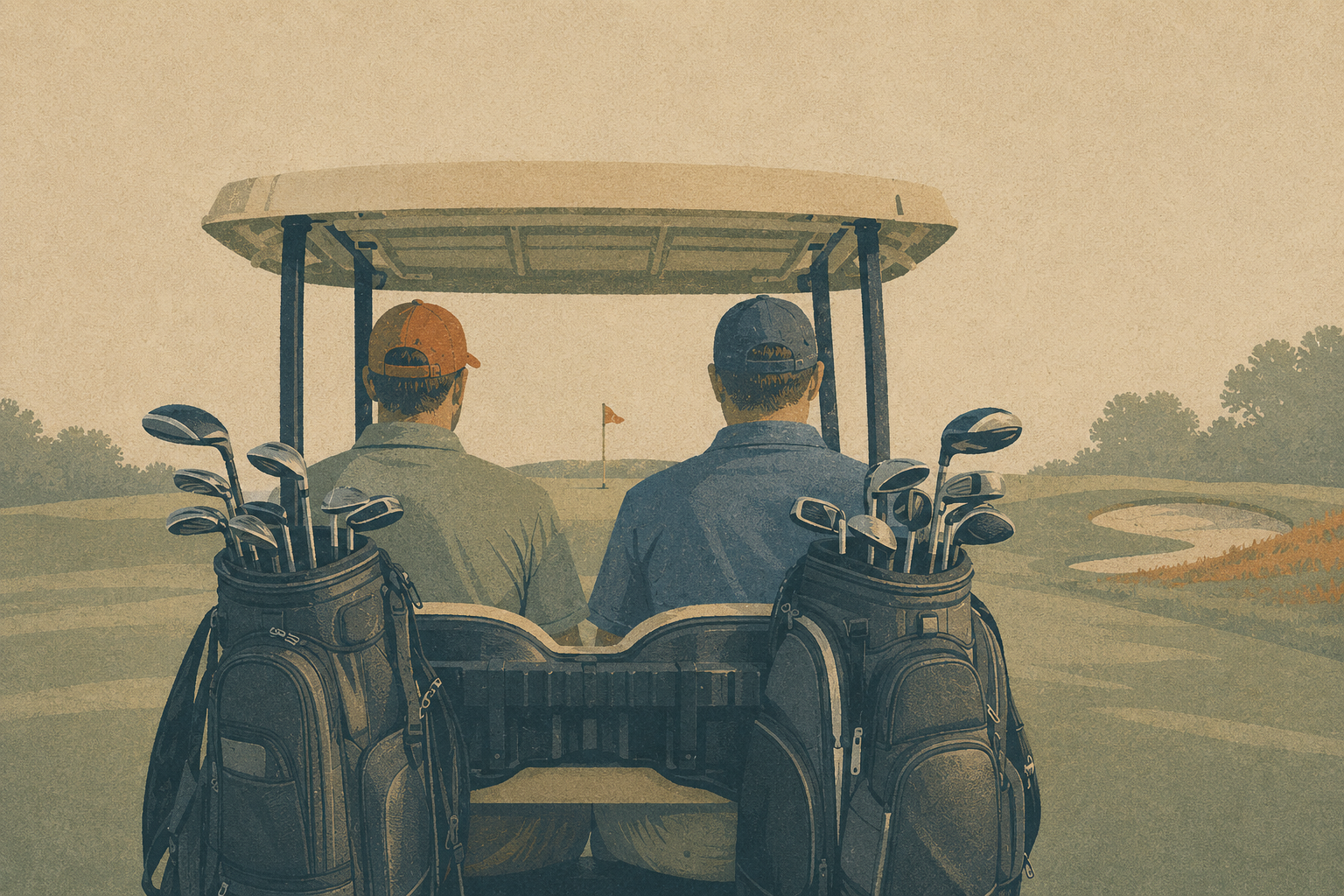
You’re playing well. Then your partner hits one out of bounds, slams his club, and mutters his way to the cart. Or maybe your partner is constantly talking in between shots, or even while you are hitting your shot. A few minutes later you’re tight over the ball for no reason you can name. You chunk a chip you’d normally hit in your sleep.
Nothing happened to you. But something happened to you.
The Contagion Effect
The human brain is wired to pick up the emotional states of people around it, often before we’re consciously aware we’re doing it. Neuroscientists call part of this mechanism mirror neurons—cells that fire both when we act and when we watch someone else act, effectively simulating their experience inside us. Tension, frustration, urgency—these transfer between people the same way a yawn does. Nobody decides to catch it.
On a golf course this matters more than almost anywhere else. Golf is slow. You spend four hours in close proximity to two or three other people, watching them succeed and fail in real time, with long stretches of silence in between for their state to seep into yours. A tense group plays tense golf. A loose group plays loose golf. This has nothing to do with anyone’s swing mechanics and everything to do with whose nervous system you’ve been standing next to for the last two hours.
This is exactly why your Flow Index can dip on a day when your swing feels fine. The index is a system that measures your state of mind for all your shots, every hole, even an entire round. It’s separate from mechanics or stroke count.
Theoretically your state of mind is 100% under your control, but the reality is external events can disrupt your ability to maintain complete control. When that happens we need tools at the ready that help us get back on the control track.
Choose Wisely
When you have a say in who you play with, pay attention to more than just handicap and tee time.
Watch how someone handles their own bad shots. Do they reset quickly or carry it to the next hole? Watch their pace. A rushed partner will pull you out of your routine without either of you noticing. Watch whether they talk during your pre-shot routine or respect it with silence. None of this makes someone a bad person to have a beer with. It just means they may not be who you want next to you when you’re trying to protect a good round.
The best playing partners aren’t necessarily the best players. They’re the ones whose state of mind you’d be glad to catch.
Stick to Your Game Plan
At some point you will be paired with an exceptional golfer. He hits it a mile and straight off the tee, his irons are rock solid, and his short game is crisp. He will go for the green in two on every par 5. Resist the temptation to keep up with him. If you normally lay up on par 5’s, continue to do so. Don’t give into any perceived peer pressure. Stay on plan.
Handling It When You Don’t Have a Choice
Most of the time you don’t get to pick your group. Leagues assign you. Work outings assign you. Public courses pair you with strangers. So the more useful skill isn’t picking better partners—it’s building a wall their state can’t get through.
A few ways to do that:
Protect your pre-shot routine like it’s sacred, regardless of what’s happening around you. The same sequence, the same pace, every time, no matter who’s watching or how fast the group behind is pushing.
Use their bad energy as a cue instead of letting it become your energy. The moment you notice a partner’s frustration, tension, or rushing start to land on you, treat that noticing as your reset signal. A breath, a word, a physical trigger—whatever you already use to get back to center. Their bad hole doesn’t have to become your bad hole. It can become the reminder to check in with yourself.
Give yourself permission to not fix them. You’re not responsible for your partner’s state. You’re only responsible for what you do with it once you notice it in yourself.
You’re Someone’s Playing Partner Too
It’s easy to read all of this and think about the guy who tilted your round last Saturday. But the contagion runs both ways. You are exactly as capable of leaking tension, impatience, or frustration into the group as anyone else is.
The steadier you get, the more you become the kind of playing partner other people are lucky to have—the one whose calm is contagious instead of whose tilt is. That’s worth as much to your own score as it is to theirs. A calm group plays calm golf, and you get to help decide which kind of group you’re in.
Read more in Swing to Flow: A Mindful Approach to Better Golf.
Leave a Reply