

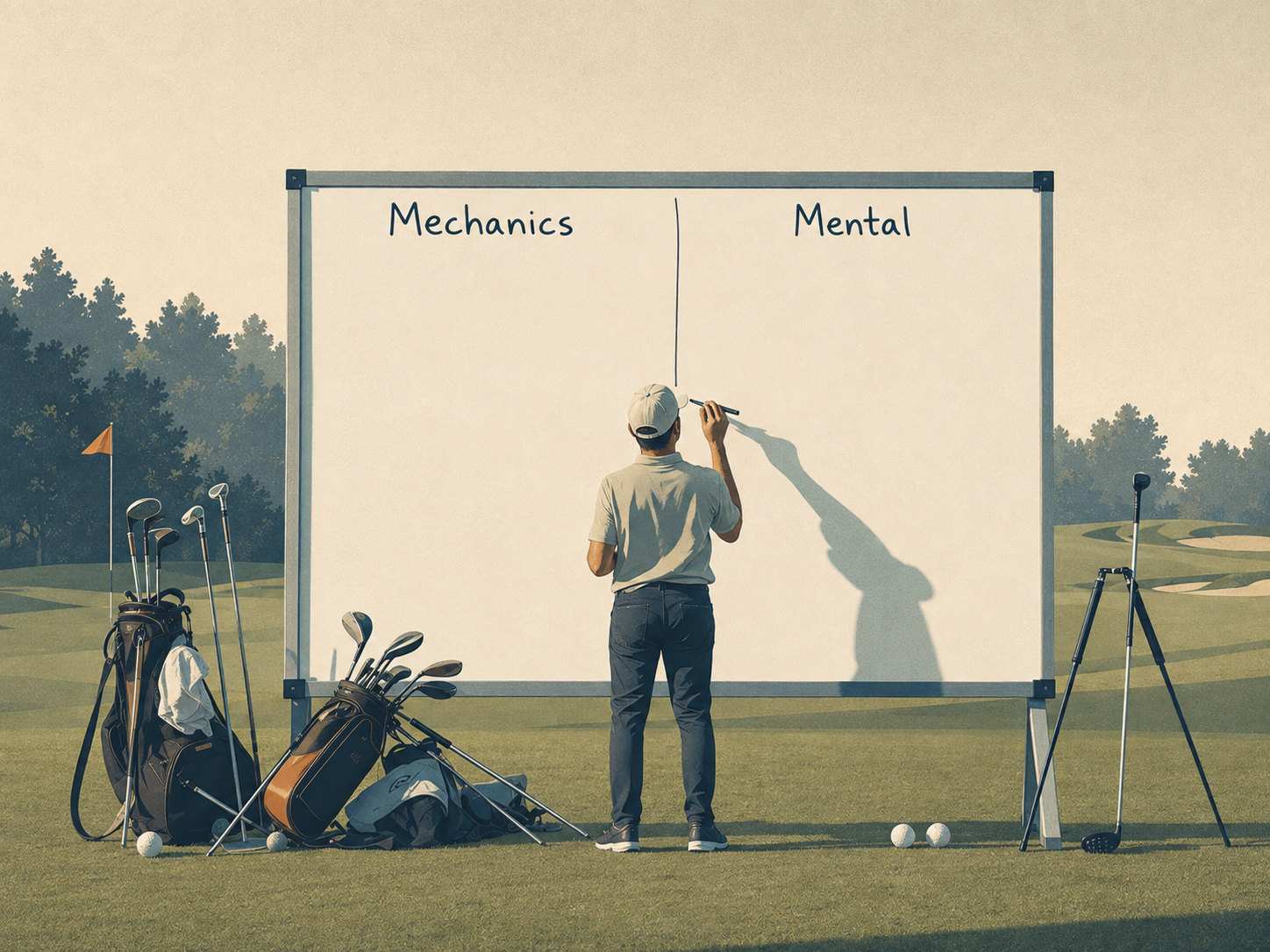
Try this exercise. Grab a piece of paper and draw a vertical line down the middle. Label one column “Mechanics” and the other “Mental.” Now list the things you practice in each category.
Take your time. Be honest.
The Disparity
If you’re like most golfers, the mechanics column filled up quickly. Grip. Stance. Backswing. Weight transfer. Follow-through. Chipping from tight lies. Putting. You’ve worked on these things for years—on the range, in lessons, through books and videos. You know what mechanics practice looks like.
The mental column is probably shorter. Maybe much shorter. Maybe empty.
When I ask golfers to estimate the ratio of their mechanics practice to mental practice, the answer is almost always the same: 90% mechanics, 10% mental. I’m skeptical.
The ratio should be 50% Mechanics 50% Mental.
Why This Happens
We can see and feel our physical game. When something goes wrong, we notice it—a slice, a chunk, a missed putt. Practice feels tangible. You hit balls, watch the flight, make adjustments. You learned it by observing others, reading instruction, or working with a pro. Mechanics drills are everywhere. You’ve probably invented a few yourself.
Has anyone ever taught you how to practice your mental game?
You can’t observe it in others. You can’t even observe it in yourself—it’s invisible. How do you define or practice something you can’t see, something that rarely comes up in conversations during or after the round?
Mental Without Method
If you listen carefully, tour pros mention the mental game. Commentators talk about it. But notice what they actually say: focus, composure, mental toughness, staying in the moment. After his first PGA tour win, Tommy Fleetwood said he had “…been in the flow.”
The same vague words, repeated endlessly.
What does “focus” mean, specifically? How do you develop “composure”? What is “mental toughness” or “flow,” and how do you practice it? No one explains. The terms sound meaningful but remain undefined, pointing at something important without ever showing you how to get there.
This is a gap in golf instruction. Mechanics get chapters, videos, entire academies. The mental game gets a few phrases borrowed from sports psychology and left unexplained.
Consider This
What if the 90/10 ratio is backward? What if the thing you practice least is the thing holding you back most?
Those effortless shots you occasionally produce—the ones where thinking stopped and the swing just happened—prove your mechanics are good enough. What’s missing is reliable access to the mental state that produces and reproduces them.
The mental game is not mysterious. It’s not reserved for tour players or sports psychologists. It’s learnable, trainable, and practical.
But first you have to acknowledge it exists. And then you have to practice it.
The Swing to Flow process can help you develop and practice your mental game.
Leave a Reply